Hi, I'm Jonathan!

I develop ways for interactive AI agents to perceive, understand, and adapt to our ever-changing world

I recently completed my Ph.D. where my research focused primarily on developing methods for enabling AI-enabled agents to respond to unexpected changes in their environment. Using methods like reinforcement learning, large multimodal generative modals, and training in simulation, my work improves the adaptability and robustness of agent performance in the presence of such changes. Previously, I was a graduate student at the Georgia Institute of Technology in Atlanta, GA, earning my PhD in Robotics from the College of Computing. I did my PhD research in the Entertainment Intelligence and Human-Centered AI (EI+HCAI) Labs at Georgia Tech under Dr. Mark Riedl (check out his twitter!). I also collaborated in my Ph.D. with Professors Irfan Essa, Sonia Chernova, Zsolt Kira on other ways of making machine learning and autonomy adaptable to change.

I completed my Ph.D. in December 2024, defending my dissertation, Efficient Adaptation of Reinforcement Learning Agents to Sudden Environmental Change, under Dr. Riedl. Since April 2025 I've been a Senior Software Engineer at Anduril Industries, where I have worked on both the perception and autonomy teams for small UAS, including shipping a learned search capability to real aircraft using a hybrid of reinforcement learning, imitation learning, classical planning, and developing and shipping core search capabilities for these platforms.

Before my Ph.D. I was a Robotics Engineer at Intelligent Automation, Inc. in Rockville, MD. There I focused on finding autonomous vehicle and smart device solutions under DoD research grants, specializing in creating sliding autonomy systems for teleoperators to interactively teach robots tasks and using computer vision to improve teleoperation of field robots. I earned my Masters Degree in Robotics from the University of Pennsylvania in Philadelphia, PA, and my Bachelors Degree in Physics and Mathematics from Georgetown University in Washington, D.C. For more details, check out my C.V.!

Sometimes I let this website get out of date. For the most up-to-date professional information, check out my LinkedIn.

Recent News

Just a few things that I have been up to:

  • (Apr 2025) I joined Anduril Industries as a Senior Software Engineer, founding a new small UAS autonomy team focused on learned search capabilities for real aircraft.
  • (Dec 2024) I completed my Ph.D. in Computer Science (Robotics) at Georgia Tech! My dissertation, Efficient Adaptation of Reinforcement Learning Agents to Sudden Environmental Change, is available on arXiv.
  • (2024) Our work "Characteristics of Effective Exploration for Transfer in Reinforcement Learning" was accepted to the RLC 2024 Finding the Frame Workshop.
  • (2023) Our paper "Neuro-Symbolic World Models for Adapting to Open World Novelty" was accepted to AAMAS 2023.
  • (Mar 2022) I gave a long talk at the AAAI 2022 Spring Symposium on Designing Artificial Intelligence for Open Worlds. The talk described our research developing NovGrid environment and accompanying ontology.
  • (May 2021) Beginning my summer internship at SRI International. I will be working on using reinforcement learning to learn generative models for generating interpretable multi-agent policies based on Behavior Trees.
  • (April 2021) Our work on Semi-Supervised Continual Learning was accepted to IJCNN! We were accepted for a short oral that we will present at the virutal conference this summer.
  • (Mar 2020) I was awarded a Public Interest Technology Universities Network (PITUN) Fellowship! I will be working with Bill Sabol, a Georgia State University Criminology professor, on how machine learning can help parole officers identify which behaviors and technique reduce recidivism.
  • (July 2019) Our team won the FetchIt!: The Mobile Manipulation Challenge! with fellow collaborators in the Robot Autonomy and Interactive Learning (RAIL) lab led by Sonia Chernova at Georgia Tech we won the lab a new Fetch robot plus $7K in funds from SCHUNK.
  • (Feb 2019) Our work on Robot Tool Macguyvering was accepted to ICRA! We will present the poster at the conference in Montreal this summer.
  • (May 2018) Beginning my summer internship at Google AI in the Mobile Vision Group where I will be developing low-shot learning methods with intelligent batch construction using online importance sampling.
  • (July 2017) Attended RSS 2017 in Boston to present my work using synthetic data to improve semantic segmentation at the Workshop on New Frontiers for Deep Learning in Robotics and the Workshop on Spatial Semantic Representations in Robotics.

Highlighted Projects

Environment screenshot from Novelty Detection in Reinforcement Learning with World Models

Novelty Detection in Reinforcement Learning with World Models

ICML 2025 Spotlight — with Geigh Zollicoffer, Kenneth Eaton, Julia Kim, Wei Zhou, Robert Wright, and Mark Riedl

Reinforcement learning (RL) using world models has found significant recent successes. However, when a sudden change to world mechanics or properties occurs then agent performance and reliability can dramatically decline. We refer to the sudden change in visual properties or state transitions as novelties. Implementing novelty detection within generated world model frameworks is a crucial task for protecting the agent when deployed. In this paper, we propose straightforward bounding approaches to incorporate novelty detection into world model RL agents, by utilizing the misalignment of the world model's hallucinated states and the true observed states as an anomaly score. We provide effective approaches to detecting novelties in a distribution of transitions learned by an agent in a world model. Finally, we show the advantage of our work in a novel environment compared to traditional machine learning novelty detection methods as well as currently accepted RL focused novelty detection algorithms.

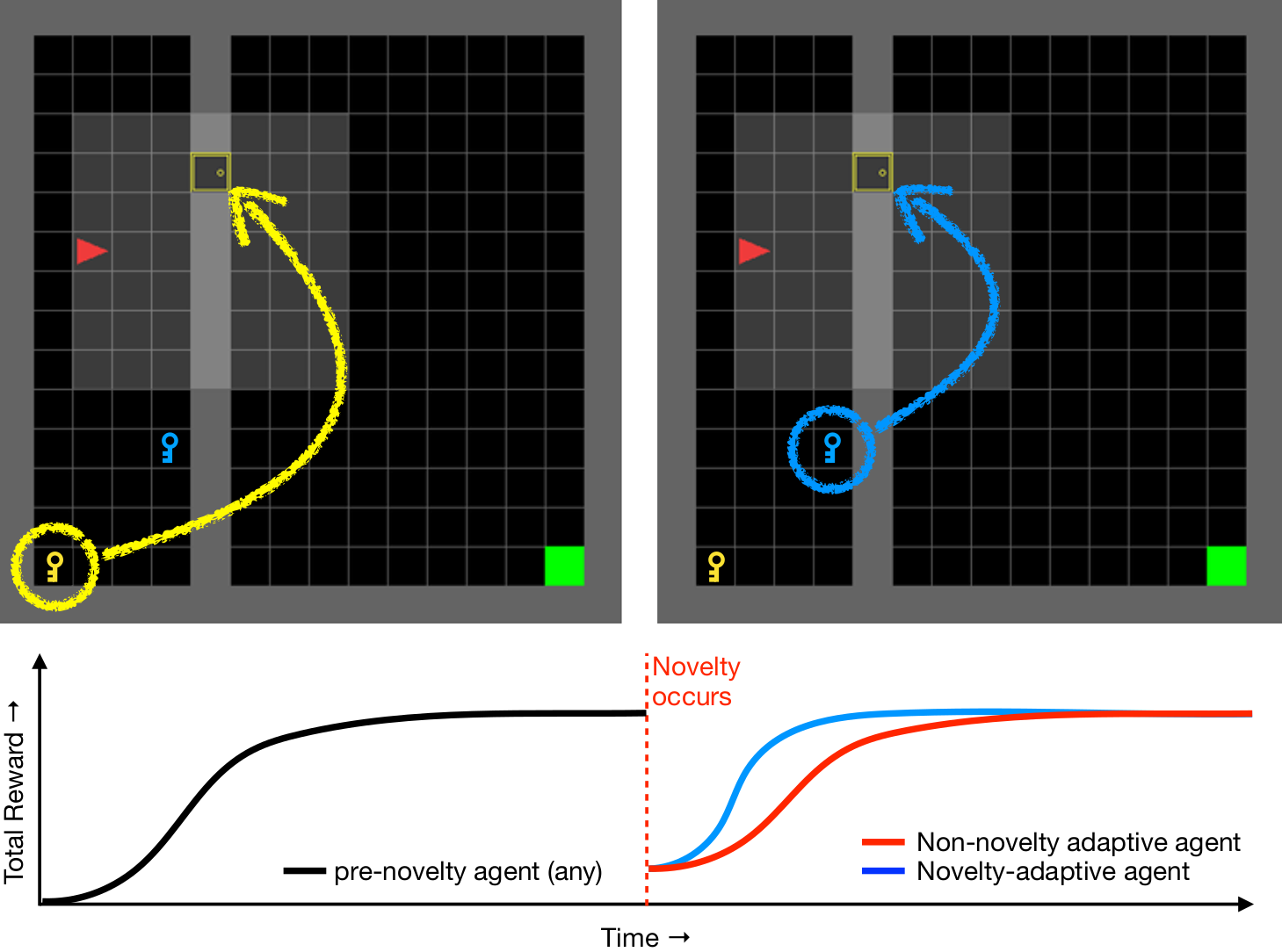
Learning curve figure from the dissertation showing recovery after a DoorKeyChange novelty

Ph.D. Dissertation: Efficient Adaptation of Reinforcement Learning Agents to Sudden Environmental Change

Georgia Institute of Technology, Dec 2024

Real-world autonomous decision-making systems, from robots to recommendation engines, must operate in environments that change over time. While deep reinforcement learning (RL) has shown an impressive ability to learn optimal policies in stationary environments, most methods are data intensive and assume a world that does not change between training and test time. As a result, conventional RL methods struggle to adapt when conditions change. This poses a fundamental challenge: how can RL agents efficiently adapt their behavior when encountering novel environmental changes during deployment without catastrophically forgetting useful prior knowledge? This dissertation demonstrates that efficient online adaptation requires two key capabilities: (1) prioritized exploration and sampling strategies that help identify and learn from relevant experiences, and (2) selective preservation of prior knowledge through structured representations that can be updated without disruption to reusable components.

Figure showing the five novelty types used to evaluate exploration transfer

Characteristics of Effective Exploration for Transfer in Reinforcement Learning

RLC 2024: Finding the Frame Workshop — with Rishav Bhagat, Geigh Zollicoffer, Ruoran Jia, Julia Kim, and Mark Riedl

In deep reinforcement learning (RL) research, there has been a concerted effort to design more efficient and productive exploration methods while solving sparse-reward problems. These exploration methods often share common principles (e.g., improving diversity) and implementation details (e.g., intrinsic reward). Prior work found that non-stationary Markov decision processes (MDPs) require exploration to efficiently adapt to changes in the environment with online transfer learning. However, the relationship between specific exploration characteristics and effective transfer learning in deep RL has not been characterized. In this work, we seek to understand the relationships between salient exploration characteristics and improved performance and efficiency in transfer learning. We test eleven popular exploration algorithms on a variety of transfer types -- or "novelties" -- to identify the characteristics that positively affect online transfer learning. Our analysis shows that some characteristics correlate with improved performance and efficiency across a wide range of transfer tasks, while others only improve transfer performance with respect to specific environment changes. From our analysis, we make recommendations about which exploration algorithm characteristics are best suited to specific transfer situations.

Figure 1 from the paper showing the NovGrid DoorKeyChange and LavaProof novelty environments

Neuro-Symbolic World Models for Adapting to Open World Novelty

AAMAS 2023 — with Zhiyu Lin, Robert Wright, Xiangyu Peng, Mustafa Hussain, Aarun Srinivas, Julia Kim, and Mark Riedl

Open-world novelty--a sudden change in the mechanics or properties of an environment--is a common occurrence in the real world. Novelty adaptation is an agent's ability to improve its policy performance post-novelty. Most reinforcement learning (RL) methods assume that the world is a closed, fixed process. Consequentially, RL policies adapt inefficiently to novelties. To address this, we introduce WorldCloner, an end-to-end trainable neuro-symbolic world model for rapid novelty adaptation. WorldCloner learns an efficient symbolic representation of the pre-novelty environment transitions, and uses this transition model to detect novelty and efficiently adapt to novelty in a single-shot fashion. Additionally, WorldCloner augments the policy learning process using imagination-based adaptation, where the world model simulates transitions of the post-novelty environment to help the policy adapt. By blending "imagined" transitions with interactions in the post-novelty environment, performance can be recovered with fewer total environment interactions. Using environments designed for studying novelty in sequential decision-making problems, we show that the symbolic world model helps its neural policy adapt more efficiently than model-based and model-based neural-only reinforcement learning methods.

images/ThailandProfile.png

NovGrid: A Flexible Grid World for Evaluating Agent Response to Novelty

[Long Oral] AAAI 2022 Spring Symposium on Designing Artificial Intelligence for Open Worlds

A robust body of reinforcement learning techniques have been developed to solve complex sequential decision making problems. However, these methods assume that train and evaluation tasks come from similarly or identically distributed environments. This assumption does not hold in real life where small novel changes to the environment can make a previously learned policy fail or introduce simpler solutions that might never be found. To that end we explore the concept of {\em novelty}, defined in this work as the sudden change to the mechanics or properties of environment. We provide an ontology of for novelties most relevant to sequential decision making, which distinguishes between novelties that affect objects versus actions, unary properties versus non-unary relations, and the distribution of solutions to a task. We introduce NovGrid, a novelty generation framework built on MiniGrid, acting as a toolkit for rapidly developing and evaluating novelty-adaptation-enabled reinforcement learning techniques. Along with the core NovGrid we provide exemplar novelties aligned with our ontology and instantiate them as novelty templates that can be applied to many MiniGrid-compliant environments. Finally, we present a set of metrics built into our framework for the evaluation of novelty-adaptation-enabled machine-learning techniques, and show characteristics of a baseline RL model using these metrics.

images/ThailandProfile.png

Memory-Efficient Semi-Supervised Continual Learning: The World is its Own Replay Buffer

[Short Oral] 2021 International Joint Conference on Neural Networks (IJCNN)

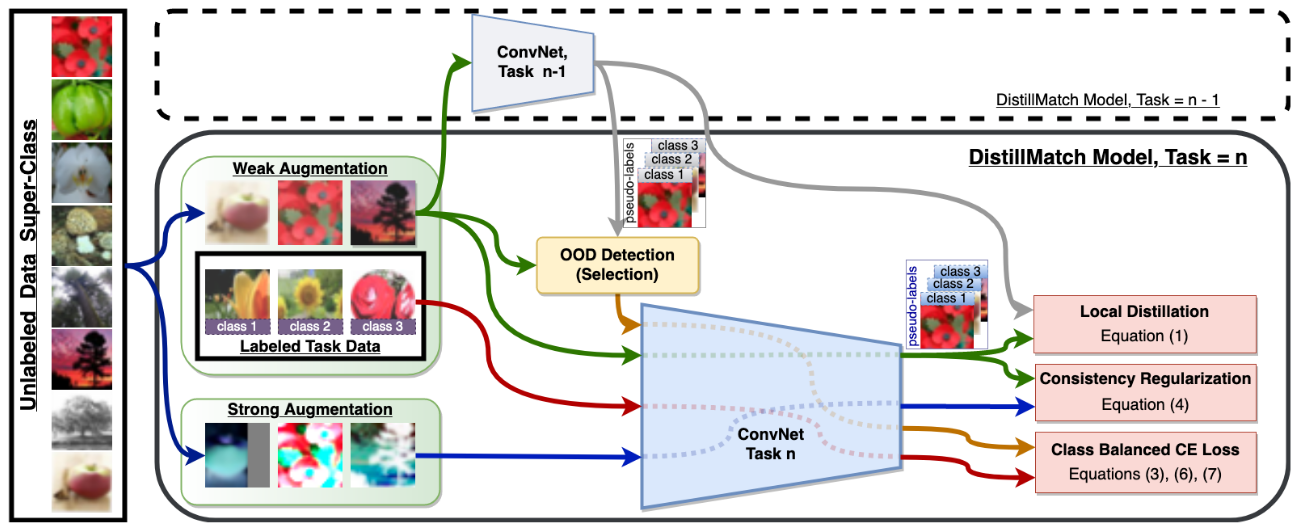
Rehearsal is a critical component for class-incremental continual learning, yet it requires a substantial memory budget. Our work investigates whether we can significantly reduce this memory budget by leveraging unlabeled data from an agent's environment in a realistic and challenging continual learning paradigm. Specifically, we explore and formalize a novel semi-supervised continual learning (SSCL) setting, where labeled data is scarce yet non-i.i.d. unlabeled data from the agent's environment is plentiful. Importantly, data distributions in the SSCL setting are realistic and therefore reflect object class correlations between, and among, the labeled and unlabeled data distributions. We show that a strategy built on pseudo-labeling, consistency regularization, Out-of-Distribution (OoD) detection, and knowledge distillation reduces forgetting in this setting. Our approach, DistillMatch, increases performance over the state-of-the-art by no less than 8.7% average task accuracy and up to 54.5% average task accuracy in SSCL CIFAR-100 experiments. Moreover, we demonstrate that DistillMatch can save up to 0.23 stored images per processed unlabeled image compared to the next best method which only saves 0.08. Our results suggest that focusing on realistic correlated distributions is a significantly new perspective, which accentuates the importance of leveraging the world's structure as a continual learning strategy.

images/ThailandProfile.png

Tool Macgyvering: Tool Construction Using Geometric Reasoning

2019 International Conference on Robotics and Automation (ICRA)

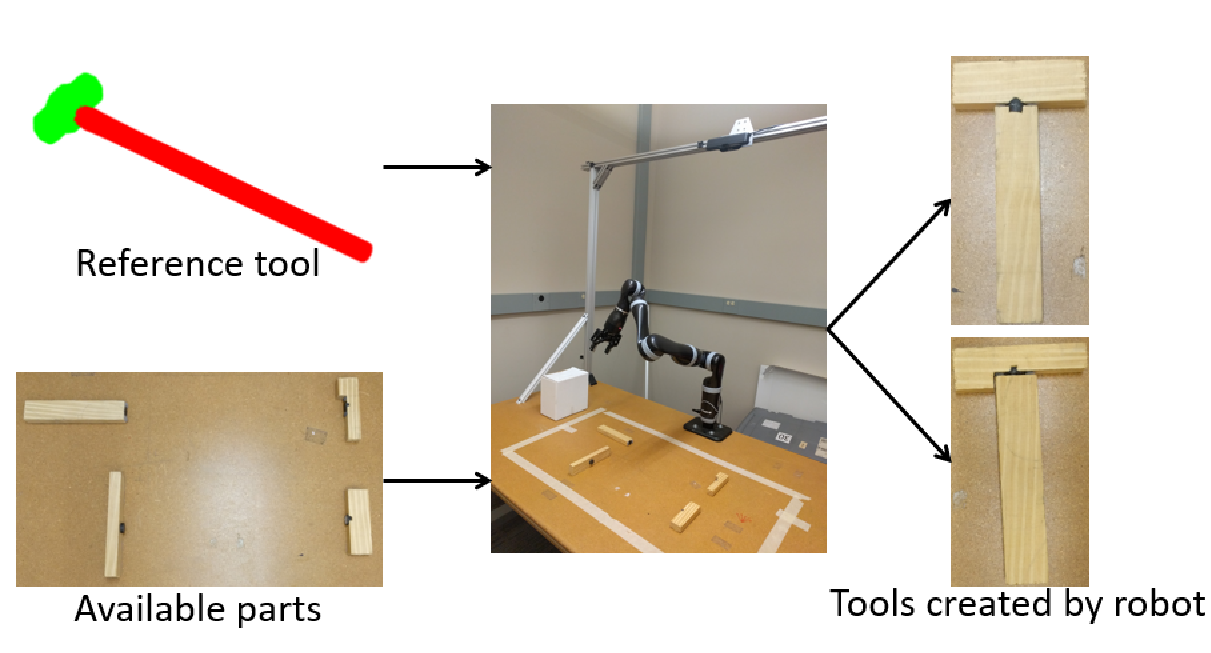
MacGyvering is defined as creating or repairing something in an inventive or improvised way by utilizing objects that are available at hand. In this paper, we explore a subset of Macgyvering problems involving tool construction, i.e., creating tools from parts available in the environment. We formalize the overall problem domain of tool Macgyvering, introducing three levels of complexity for tool construction and substitution problems, and presenting a novel computational framework aimed at solving one level of the tool Macgyvering problem, specifically contributing a novel algorithm for tool construction based on geometric reasoning. We validate our approach by constructing three tools using a 7-DOF robot arm.

Unbiasing Semantic Segmentation For Robot Perception using Synthetic Data

RSS 2017 Workshop on New Frontiers for Deep Learning

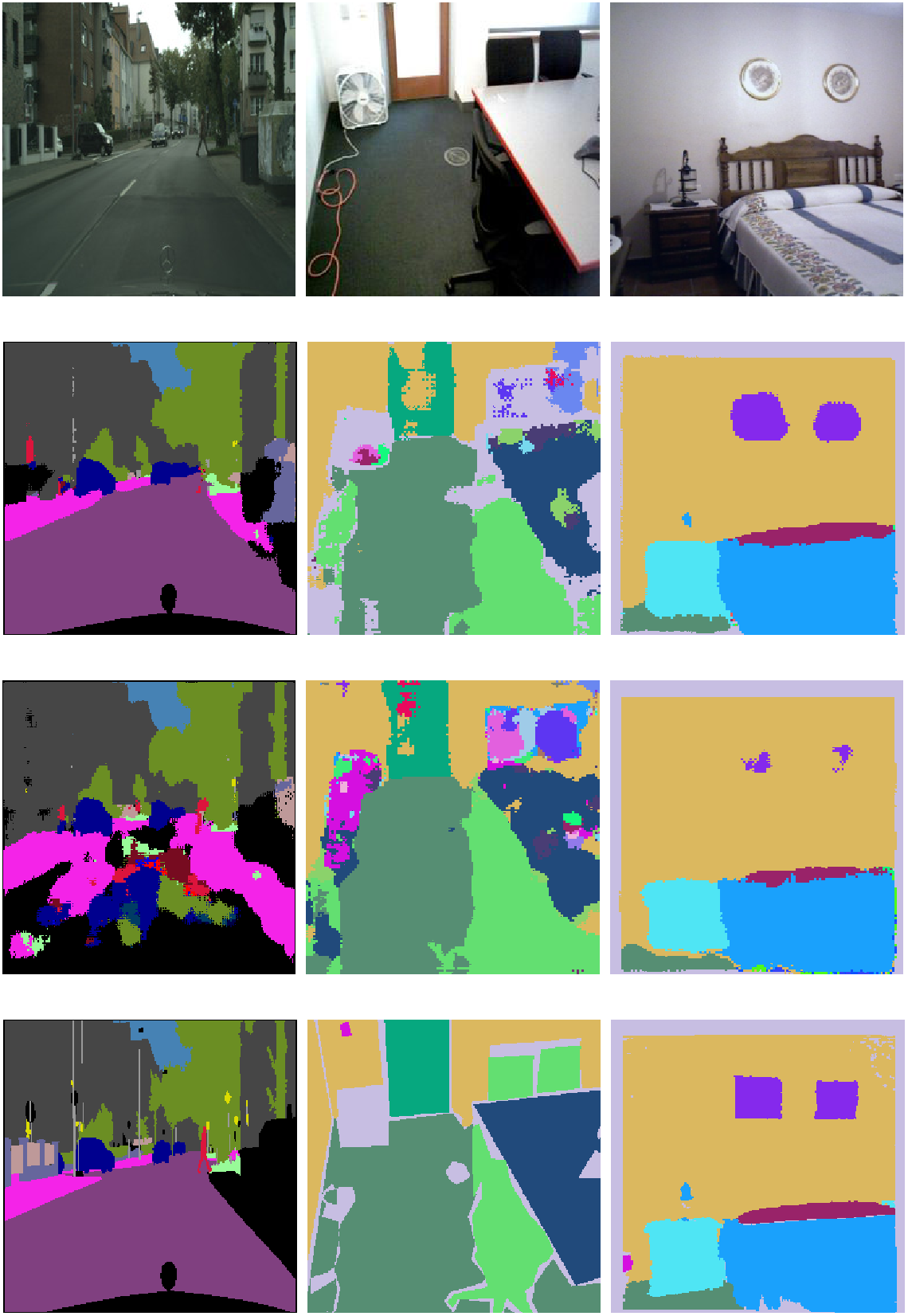
The ability of a robot to reason about the geometry and semantics of its environment is fundamental to interactive robot behaviors, but often challenging due to perception frameworks that are trained on too little data or data not representative of the robots environment. In this work, we investigate the potential gains of using synthetic data to augment the training process of convolutional neural networks designed to enable real-time semantic segmentation for robots with limited real-world training data. We investigate the degree to which a larger amounts of data improves performance when training such a model, the relationship between the way a deep neural network is trained using multiple sources of synthetic segmentation data to pretrain standard segmentation datasets that apply to robotics and autonomous driving, and show that our method outperforms both training from scratch and standard data augmentation practices like pretraining on ImageNet. We show that synthetic data does continue to improve these models in spite of real-time model architectures having many fewer parameters than typical deep neural networks, and therefore hypothetically less representational power. Finally, we show how this approach generalizes to small purpose-built robot vision datasets on data acquired using an HRI robot.

Contact Me

If you have any questions for me please feel free to e-mail me at jon.balloch@gmail.com.